Clothing
WHAT ARE YOU WEARING?
The Vibration of Fabrics & Why It Matters
How Your Clothing Affects Your Health, Energy, and Mood
Most people never question how clothing affects their health beyond “staying warm in winter” or “looking good.” We think about style, fashion, comfort, or function — but rarely about the materials themselves.
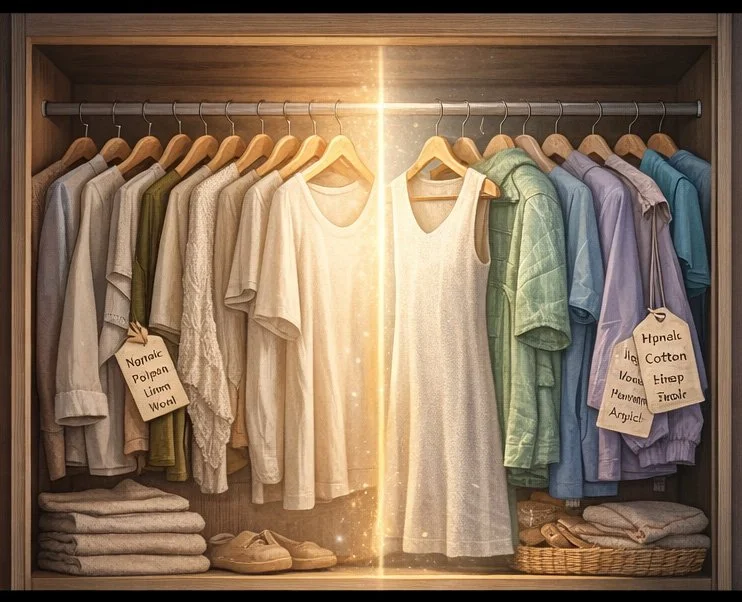
Yet, what your clothing is made of may matter far more than you have taught.
Natural Fabrics vs Synthetic Fabrics
Over the years, I’ve come to understand that natural fabric clothing vibrates differently than synthetics. Many in the wellness space are now talking about the energetic and physiological impacts of clothing materials.
Here is one short reel that speaks to vibrational frequencies of fabrics:
👉 https://www.youtube.com/shorts/9_IFZMnKDaw
According to information circulating in that community:
Linen and Wool reportedly vibrate at ~5,000 MHz
Organic Cotton around 100–110 MHz
Regular Cotton around 70 MHz
Healthy Human Body vibrates around 70–100 MHz
By contrast:
Leather is reported around 30 MHz
Acrylic, Polyester, and Nylon are considered low vibration and typically contain petrochemical residues and positive ions which are the ones that make you feel bad.
Whether you take the vibrational numbers literally or symbolically, many sensitive people notice a tangible difference.
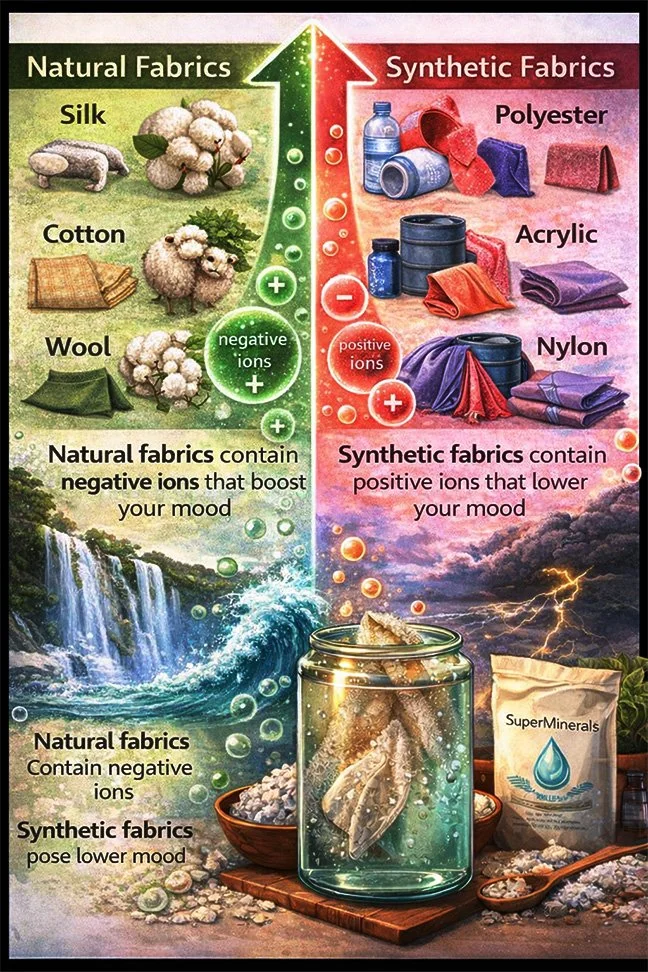
Natural Fabrics Contain Negative Ions
A commonly discussed concept is that:
NATURAL FABRICS = higher negative ion presence
SYNTHETICS = higher positive ion presence
Negative ions are associated with a sense of well-being — the same feeling we get around:
✔ Waterfalls
✔ Ocean waves
✔ Rainstorms
✔ Mountain air
Positive ions, on the other hand, are associated with:
✘ Headaches
✘ Irritability
✘ Fatigue and discomfort
Personally, when I wear synthetic fabrics, I get headaches, feel like I’m suffocating, weaker and get irritable. If a storm front rolls in (which also brings positive ions), I am almost guaranteed a migraine if wearing synthetics. Once the rain actually starts, moving water produces negative ions and I feel the shift to better.
This is the same reason people are drawn to waterfalls, beaches, and rivers — they change our energy.
I first learned about ions while teaching Physical Science at WVU, and since then I have slowly shifted my wardrobe toward natural, mostly organic fabrics.
Why Washing Matters
Here are two helpful short clips about fabric and health:
👉 https://www.youtube.com/shorts/eNWIsGoKCJc
👉 https://www.youtube.com/shorts/XpEY7_IXFSE
One reason non-organic cotton should be washed (and ideally dried outdoors), or soaked in Superminerals noted below, is because cotton is one of the most heavily sprayed crops in the world. Cotton is not regulated like food.
A story shared by the Midwestern Doctor on Substack illustrates this well:
“Years ago, a friend of mine was seated on a plane next to a chief executive of a major American chemical company notorious for polluting the environment. After a friendly conversation, my friend asked the executive what his most important advice was. The executive immediately replied:
‘Always wash new clothes before you put them on.’”
Do Organics Make a Difference?
Someone recently asked me if organic clothing really matters. Subjectively, I feel the difference, especially with my organic bras. Now there is vibrational measurement circulating that supports this experience. Organics generally mean:
✔ Fewer pesticides
✔ Fewer chemical residues
✔ Higher comfort for sensitive skin
✔ Higher vibration frequencies better support our well-being
Natural Plant, Animal vs Semi-Synthetic vs Synthetic
Natural Fabrics
Come directly from plants or animals:
Plant: cotton, linen, hemp, bamboo, jute, ramie, etc.
Animal: wool, alpaca, cashmere, silk, yak, etc.
Leather: natural but low vibration compared to plant fibers
Semi-Synthetic Fabrics
Made from natural materials but chemically processed (synthecized, not raw or totally natural):
Rayon Modal Bamboo Viscose Lyocell Cupro
Synthetic Fabrics
Petrochemical-based: Polyester Acrylic Nylon Spandex
These often contain endocrine disruptors and other chemicals that may not be healthy pressed against the skin all day. Plastic micro- fibers from textiles is also a rising health concern.
SOURCES FOR ORGANIC CLOTHING brands offering natural/organic options:
Costco - organic Turkish sheets (Queen size $36!!!)
Pact: https://wearpact.com/
Maggie’s Organics https://maggiesorganics.com
MATE the Label https://matethelabel.com
Organic Basics https://organicnaturals.shop Products
Fair Indigo https://www.fairindigo.com/
Harvest & Mill: https://harvestandmill.com/
The Tibetan Monks sell a fantastic YAK shawl and blanket, wool meditation shawls and other items of high quality and natural fabrics.
LOOK for ORGANIC SHEETS, Matresses, sleepwear - you spend a lot of time in bed, so why not organic?
Up-scale consignment stores often carry gently used natural fibers and sometimes have designated organic sections. Make sure they don’t smell of perfume or dryer sheets which many sensitive people can’t tolerate.
Try This Experiment

Put on all natural fabrics (linen or organic cotton, wool or cashmere if it’s cold).
Wrap one hand in a natural organic fabric.
Sit in meditation and observe how the hand and arm feels.
Then repeat with acrylic or polyester wrapped around the hand.
Pay close attention and note the differences.
Many of us are “canaries in the mine” — we feel the difference immediately. Others need to tune in more subtly. Either way, you may be surprised at the difference when you pay close attention away from distractions.
Complete List of Natural Fabrics
🌿 Plant-Based Fibers
Linen (flax) Hemp Bamboo (mechanically processed) Ramie
Jute Kenaf Abaca (banana leaf) Coir (coconut husk) Sisal Raffia
🐑 Animal-Based Fibers
Wool (general)
Merino
Cashmere
Mohair
Alpaca
Camel hair
Llama wool
Yak wool
Vicuna wool
Angora (rabbit)
Silk (mulberry, tussah, eri, muga)
🍄 NEW Emerging Regenerative Bio-Fibers
These are processed, but still natural and biodegradable:
Mycelium (mushroom leather)
Coconut leather (Malai)
Piñatex (pineapple leaf)
Apple leather
Cork fabric
Superminerals for Detoxing Fabrics
Soaking non-organic fabrics in Superminerals can help draw out chemical residues, especially in cotton and other natural fibers. It likely does not help with acrylic, polyester, or nylon. For Superminerals, contact:
Julie Collins, Peak Wellness & Feng Shui
📞 678-681-4140 (Eastern Time)
Final Thoughts
Check your wardrobe. Notice how different fabrics make you feel — physically, emotionally, and energetically.
If you already experience this, please share in the comments.
If this is new to you, experiment and report back!
Thanks for reading. 🌿
REFERENCES:
Akhil, K., & Mohan, S. (2021). Microplastic fibers from synthetic textiles: Environmental and health impacts. Environmental Chemistry Letters, 19(3), 2023–2040. https://doi.org/10.1007/s10311-020-01174-3
Cotton Inc. (n.d.). The case for cotton: A natural alternative to synthetics. Lifestyle Monitor. Retrieved January 2026, from https://lifestylemonitor.cottoninc.com/the-case-for-cotton-a-natural-alternative-to-synthetics/
Environmental Working Group. (2025, December). Does your laundry shed microplastics? EWG. Retrieved from https://www.ewg.org/news-insights/news/2025/12/does-your-laundry-shed-microplastics
Lee, S., Kim, H., & Park, E. (2023). Microplastics and their interactions with the human gut microbiota. Environmental Science & Technology Letters, 10(6), 521–529. https://doi.org/10.1021/acs.estlett.3c00172
Li, Y., Gao, R., & Ding, L. (2021). Microplastic pollution from synthetic textiles during domestic washing. Water Research, 201, 117293. https://doi.org/10.1016/j.watres.2021.117293
Midwestern Doctor, Substack, January’s open thread. How Your Clothes and Their Materials Shape Your Health. Link
Pillar Advocates. (2024). Understanding fabric choices and their impact on health. Pillar Advocates Health Blog. Retrieved from https://pillaradvocates.com/understanding-fabric-choices-and-their-impact-on-health/
Sherratt, S., & Rhodes, C. (2024). Human exposure pathways to microplastics and potential health effects. Journal of Environmental Medicine, 28(4), 155–170. https://doi.org/10.1080/13546775.2024.1920531
Shin, J. Y., Kim, M. J., & Lee, S. J. (2021). Impact of textile fibers on atopic dermatitis: Comparison of cotton and synthetic fabrics. Dermatitis, 32(4), 231–239. https://doi.org/10.1097/DER.0000000000000770
Thompson, R. C., Moore, C. J., Andrady, A. L., Gregory, M. R., Takada, H., & Weisberg, S. B. (2021). Plastic microfibers from textiles: An emerging environmental health issue. Marine Pollution Bulletin, 175, 113–135. https://doi.org/10.1016/j.marpolbul.2021.113135
Zhang, H., Chen, Q., & Yang, Y. (2024). Potential respiratory hazards of airborne microplastics from synthetic textiles. Frontiers in Public Health, 12, 112233. https://doi.org/10.3389/fpubh.2024.112233